Choosing the right Bearing in 2026 starts with the machine, not the catalogue. A pump running beside a warm boiler faces different demands from a conveyor carrying dusty loads. Load direction, speed, temperature, vibration, lubrication, and available space all shape the choice. Miss one detail, and a bearing that looks right on paper may run hot or wear early.
Bearing analyst Tedric A. Harris’s work offers a useful selection principle, paraphrased here: “Match the bearing to the real load and operating conditions, not just the nominal capacity.” That distinction matters. A deep-groove ball bearing may suit a compact motor, while combined radial and axial loads may call for a different design. Check the manufacturer’s load ratings, speed limits, fit recommendations, and lubrication guidance. Then consider sealing, maintenance access, and the cost of downtime. Small details count. A few drops of the wrong lubricant can change the outcome.
This guide explains how to compare bearing types, materials, clearances, and seals for common applications. It also considers what to verify with suppliers, including traceability and technical documentation. Conditions vary, and selection charts cannot capture every installation. That is worth admitting. Measure the shaft and housing, review actual operating data, and ask a qualified engineer when loads or failure risks are uncertain. A careful choice is rarely the flashiest one. It is the one that performs reliably in the machine you actually have.
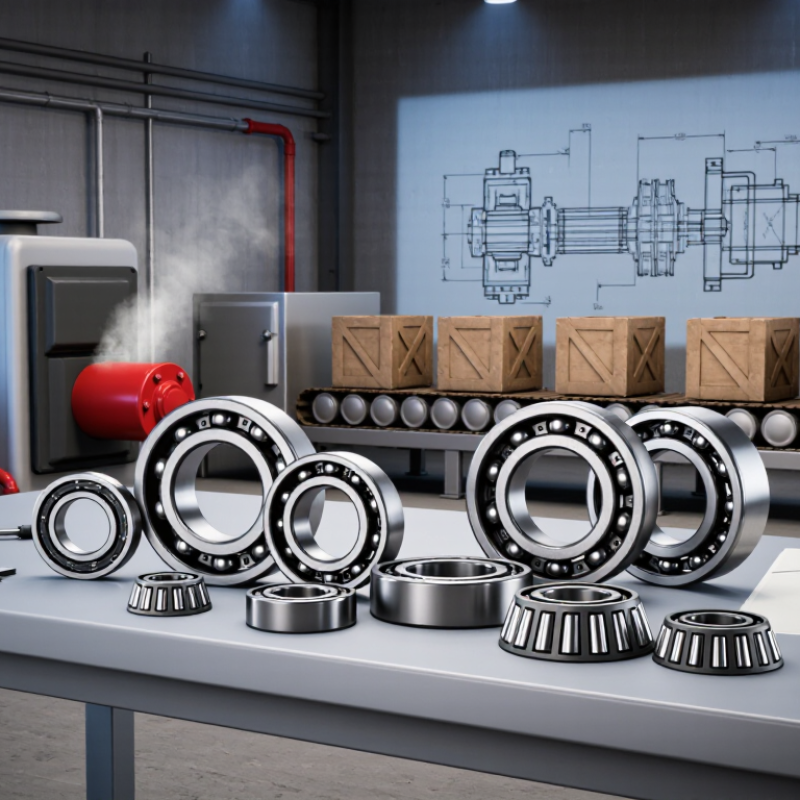
Define the Application and Operating Conditions
Define the application before selecting a bearing: record radial and axial loads, speed, direction, shock, and duty cycle. Conditions change the answer. A conveyor idler may run slowly under dust, while a pump bearing faces steady rotation, heat, and possible moisture. Note starts, stops, vibration, misalignment, shaft and housing fit, lubrication method, and available space. A clean-room specification is not useful if the real machine sees grit and washdown.
ISO 281:2007 defines basic rating life, L10, as the life reached or exceeded by 90% of a sufficiently large group of identical bearings under stated conditions. Treat that figure as a statistical estimate, not a service-life promise; contamination, poor lubrication, and installation can shorten actual life. ISO 15243:2017 classifies bearing damage, including wear, corrosion, fatigue, and electrical erosion. Its categories help connect operating evidence to failure causes. Record lubricant temperature and condition, seal leakage, and vibration at the bearing housing. Small clues matter. A spreadsheet may omit a brief overload or a cold start, and that missing detail can distort the selection. When conditions are uncertain, measure them before locking in a bearing arrangement.
Match Bearing Type to Load, Speed, and Motion
How to Choose the Right Bearing in 2026?
Match Bearing Type to Load, Speed, and Motion
Match Bearing Type to Load, Speed, and Motion
Start with the forces at the shaft. Deep-groove ball bearings suit many high-speed applications with moderate radial loads and some axial load. For heavier radial forces, cylindrical roller bearings offer greater load capacity. Angular-contact or thrust bearings handle stronger axial forces. If the shaft may bend or misalign, a self-aligning design can help. But check the actual load direction, not just the machine’s nameplate.
Speed and motion matter just as much. A continuously rotating fan differs from a conveyor that starts, stops, and reverses. Oscillating motion can concentrate wear in a small contact zone, while high speed raises heat and lubrication demands. ISO 281 provides a method for calculating bearing rating life, but its result depends on assumptions about load and operating conditions. The U.S. Department of Energy’s 2014 motor-systems sourcebook reports that motor-driven systems use about 68% of electricity in U.S. manufacturing. Bearing choice alone cannot determine efficiency, yet poor fit, lubrication, or alignment can add friction. The detail is easy to miss.
Tips: Record load, speed, temperature, contamination, and motion before choosing. Compare calculated life with real duty cycles. Check lubrication and shaft fit, too. When conditions are uncertain, measure vibration and temperature after installation. A neat calculation is useful, but it is not the whole story.
Select Materials, Lubrication, and Sealing
Choosing bearing materials starts with the environment, not the catalogue. Chrome steel suits many clean, moderate-duty applications; stainless steel can resist corrosion in washdown areas, though it may carry less load. Hybrid ceramic bearings can help where electrical currents or high speeds are concerns, but they are not a universal upgrade. Match the material to load, temperature, contamination, and shaft conditions. Small details matter. The U.S. Department of Energy’s 2021 motor-systems assessment reports that motor-driven systems use about 69% of U.S. manufacturing electricity. That makes friction and maintenance worth considering, but it does not mean a more expensive bearing automatically saves energy.
Lubrication needs the same attention. Select oil viscosity or grease consistency for operating speed, load, and temperature; a lubricant that is too thick can increase heat, while too little lubricant invites wear. Keep grease quantity and relubrication intervals grounded in the bearing maker’s technical data and actual operating conditions. I still find relubrication intervals easy to treat as fixed, even when heat and dust say otherwise. Seals should keep out water and particles without creating unnecessary drag. A contact seal may offer stronger exclusion, while a non-contact design can reduce friction in cleaner settings. ISO 281 defines basic rating life as the life at which 90% of a group of identical bearings are expected to survive under stated conditions. Treat that as a calculation, not a guarantee of field life.
How to Choose the Right Bearing in 2026? — Select Materials, Lubrication, and Sealing
Typical material density helps compare weight, but it does not determine bearing performance on its own. Steel is a common choice for general-purpose rolling bearings; silicon nitride and zirconia are ceramic options, while PEEK is a lightweight polymer used in selected applications. Choose lubrication and sealing based on operating speed, temperature, load, and exposure to contaminants.
Check Dimensions, Standards, and Compatibility
Choosing the right bearing in 2026 starts with dimensions, not a catalogue photo. Measure the shaft diameter, housing bore, and available width. Check chamfers and shoulder clearances, too. A bearing may share the same bore yet differ in outside diameter or width. Small mismatches matter.
Compare the required dimensions with the drawing and the applicable standard or dimensional series. Confirm the tolerance class and internal clearance where the application calls for them. Do not assume that similar part numbers mean interchangeable parts. Clean the shaft and housing before measuring; a thin film of dirt can distort a reading. Calipers help, but they are not ideal for every precision fit.
Then check operating compatibility. Consider load direction, speed, temperature, lubrication, seals, and exposure to dust or moisture. A bearing suited to a slow, sheltered conveyor may not work well near a hot motor. Check the equipment manual and the bearing’s published load and speed limits. Even a careful fit check can miss a detail, especially when an old assembly is worn. If the drawing and the actual machine disagree, pause and verify the fit rather than forcing the bearing into place.
How to Choose the Right Bearing in 2026? - Check Dimensions, Standards, and Compatibility
| Example Bearing |
Bearing Type / Series |
Bore (d) |
Outside Diameter (D) |
Width (B) |
Dimensional Reference |
Compatibility Checks |
| 608 |
Single-row deep-groove ball bearing; 600 series |
8 mm |
22 mm |
7 mm |
ISO 15 boundary dimensions |
Confirm the shaft is designed for an 8 mm bore and the housing for a 22 mm outside diameter; check available axial space for the 7 mm width. |
| 6001 |
Single-row deep-groove ball bearing; 600 series |
12 mm |
28 mm |
8 mm |
ISO 15 boundary dimensions |
Match the shaft and housing seats to the bearing’s nominal bore and outside diameter. Verify shoulder and retaining-feature clearances. |
| 6202 |
Single-row deep-groove ball bearing; 6200 series |
15 mm |
35 mm |
11 mm |
ISO 15 boundary dimensions |
Check the 15 mm shaft seat, 35 mm housing seat, and 11 mm axial envelope. Confirm that the selected internal clearance suits the operating conditions. |
| 6204 |
Single-row deep-groove ball bearing; 6200 series |
20 mm |
47 mm |
14 mm |
ISO 15 boundary dimensions |
Verify shaft and housing fits, shoulder diameters, and axial space. Assess radial and axial loads, speed, lubrication, and temperature before selection. |
| 6205 |
Single-row deep-groove ball bearing; 6200 series |
25 mm |
52 mm |
15 mm |
ISO 15 boundary dimensions |
Confirm a 25 mm nominal shaft seat, a 52 mm housing seat, and sufficient room for the 15 mm width. Check whether seals or shields are required. |
| 6305 |
Single-row deep-groove ball bearing; 6300 series |
25 mm |
62 mm |
17 mm |
ISO 15 boundary dimensions |
Although its bore matches the 6205, its outside diameter and width differ. Check housing and axial-space compatibility rather than relying on bore size alone. |
| 6206 |
Single-row deep-groove ball bearing; 6200 series |
30 mm |
62 mm |
16 mm |
ISO 15 boundary dimensions |
Match the 30 mm bore and 62 mm outside diameter; confirm shoulder geometry and the 16 mm width. Compare load ratings and speed limits for the specific design. |
|
Selection notes: Dimensions are nominal boundary dimensions in millimetres. ISO 15 specifies boundary dimensions for radial rolling bearings; ISO 492 covers dimensional and running tolerances. Check the applicable standard edition and the bearing manufacturer’s technical data for the exact product. Designation suffixes for seals, shields, clearance, and tolerance class can vary, so confirm their meaning in the relevant product documentation. Also verify fit, load, speed, lubrication, temperature, and contamination requirements before replacing or specifying a bearing.
|
Conclusion
Choosing the right Bearing in 2026 starts with a clear understanding of the application. Consider the operating environment, expected loads, speed, motion, temperature, and exposure to moisture, dust, or vibration. These conditions help determine whether a particular bearing type is suited to the task, including whether it must handle radial or axial loads, continuous rotation, or limited movement.
Next, compare material, lubrication, and sealing options to support reliable operation in the intended environment. Confirm that dimensions, tolerances, standards, and mounting details are compatible with the equipment. Finally, weigh expected service life, inspection needs, replacement frequency, and total lifecycle cost—not just the initial purchase price. A well-matched bearing can improve equipment performance and reduce unplanned maintenance, while careful evaluation helps avoid selecting a solution that is unsuitable for the actual operating conditions.
